
Look at this
60s Paris, a unicorn, a windy beach and looking at strangers

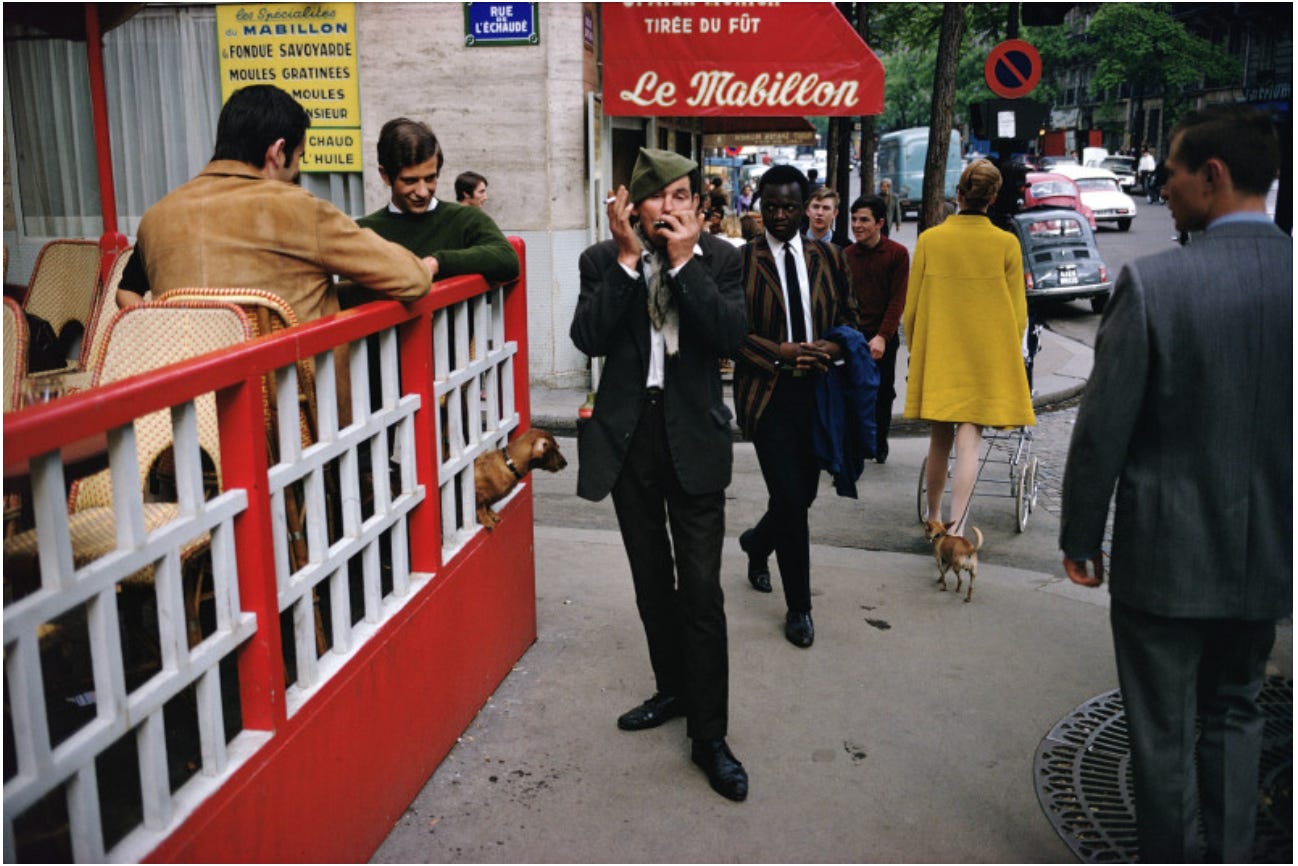
I am quietly working on a series of photographs called People in Spaces. Joel Meyerowitz is the master of the genre. I stood in front of this photograph for a long time, trying to understand why it worked so well. Was it simply a lucky click of the shutter? A fortuitous moment snatched from the flow of a day? I found myself wondering what he saw. And then it struck me: perhaps the genius of this photograph is that it is simply an offer — an invitation to look.
It is the colour that hits you first. Three reds, a splash of yellow, a green elbow, a green hat. The people are like characters in a film who suddenly turn — some toward each other, some toward the dogs, and one toward the spectacle of the man himself: cigarette in hand, green-hatted head cocked, jauntily walking and playing the harmonica. The scene is so vivid you can almost hear it — not just him, but the whole crowd: the chatter, the footsteps, the traffic.
Colour, sound, and characters — a crowd of strangers frozen in a single moment. Even the dogs commune with one another. This is a fragment of a day in Paris from 1967, and yet everything in it is alive. In the melee, everyone is connected yet separate; together only for this instant, before life resumes and they scatter, never to pass each other again. Time shrinks and expands. The photograph catches this space in the gossamer between moments.
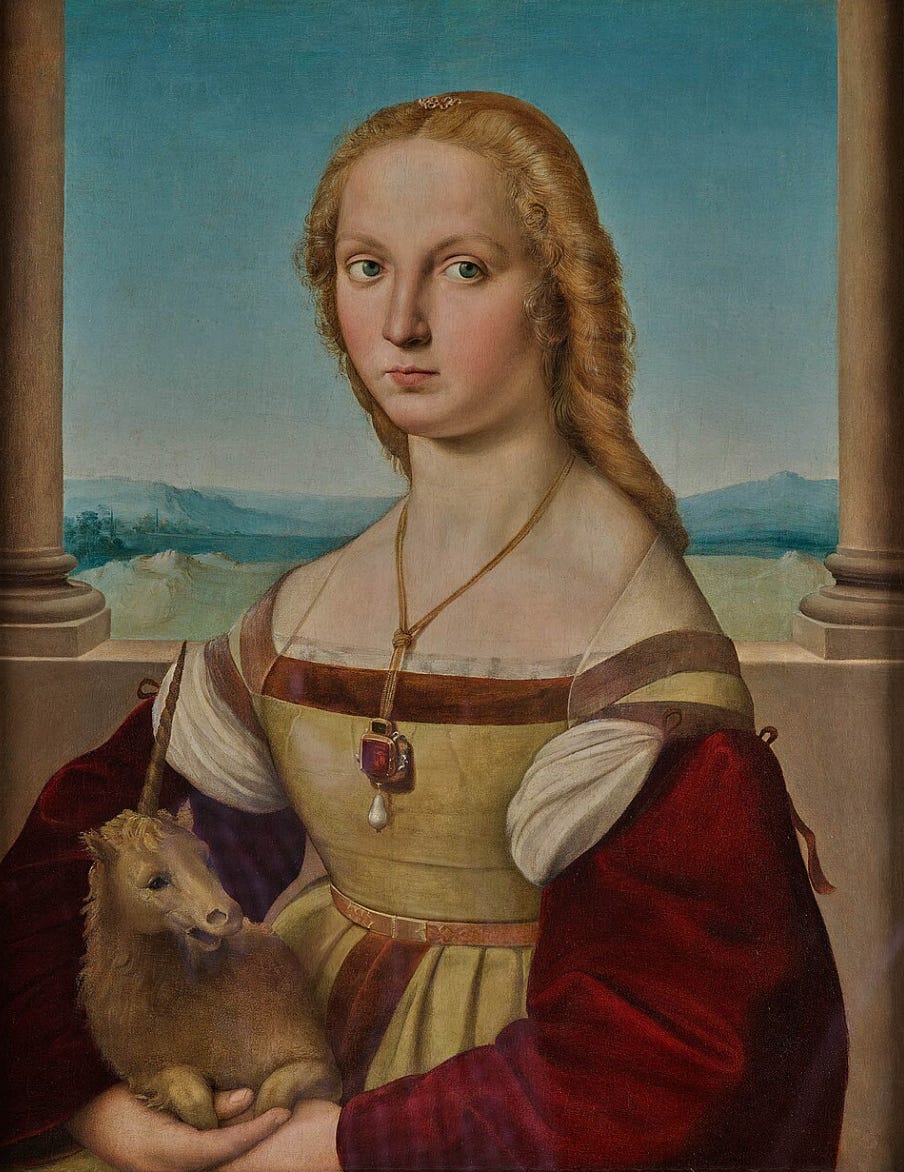
I confess, I stole this painting from Elif Shafak. In a recent essay, she wondered where our eyes linger when we look at it, and what remains when we look away. Her curiosity sparked mine, and I looked closer — really looked, for the first time, drinking in the details and sitting with the mystery. I knew this painting, but I had never truly stared at it before.
Girl with a Unicorn was painted over three times, and no one knows who the young woman is, or why she holds a unicorn.
What a charming unicorn it is. Notice the way the young woman cups its little legs so gently, and its mouth, open, as if bleating, though I imagine unicorns would have the sweetest little neigh. Her sleeves are the deepest scarlet velvet, the white underlinen puffed and bright, and together they draw the eye upward toward her necklace: a ruby, a pearl, the heft of it visible, the chain hanging heavy. It glimmers, pulling our gaze to the centre of the painting — until our eyes travel further up, and we arrive at her face.
This is a face with strong opinions and a set lip. She speaks entirely with her eyes — cool, green, watchful, and wise. I suspect she finds the whole business of sitting for a portrait a mild inconvenience, but she understands the price her beauty asks of her.
Raphael frames her with precision. The columns bracket her shoulders; the distant landscape — pasture, mountains — aligns perfectly with her neckline. Everything is held in balance. This painting is both poetry and science.
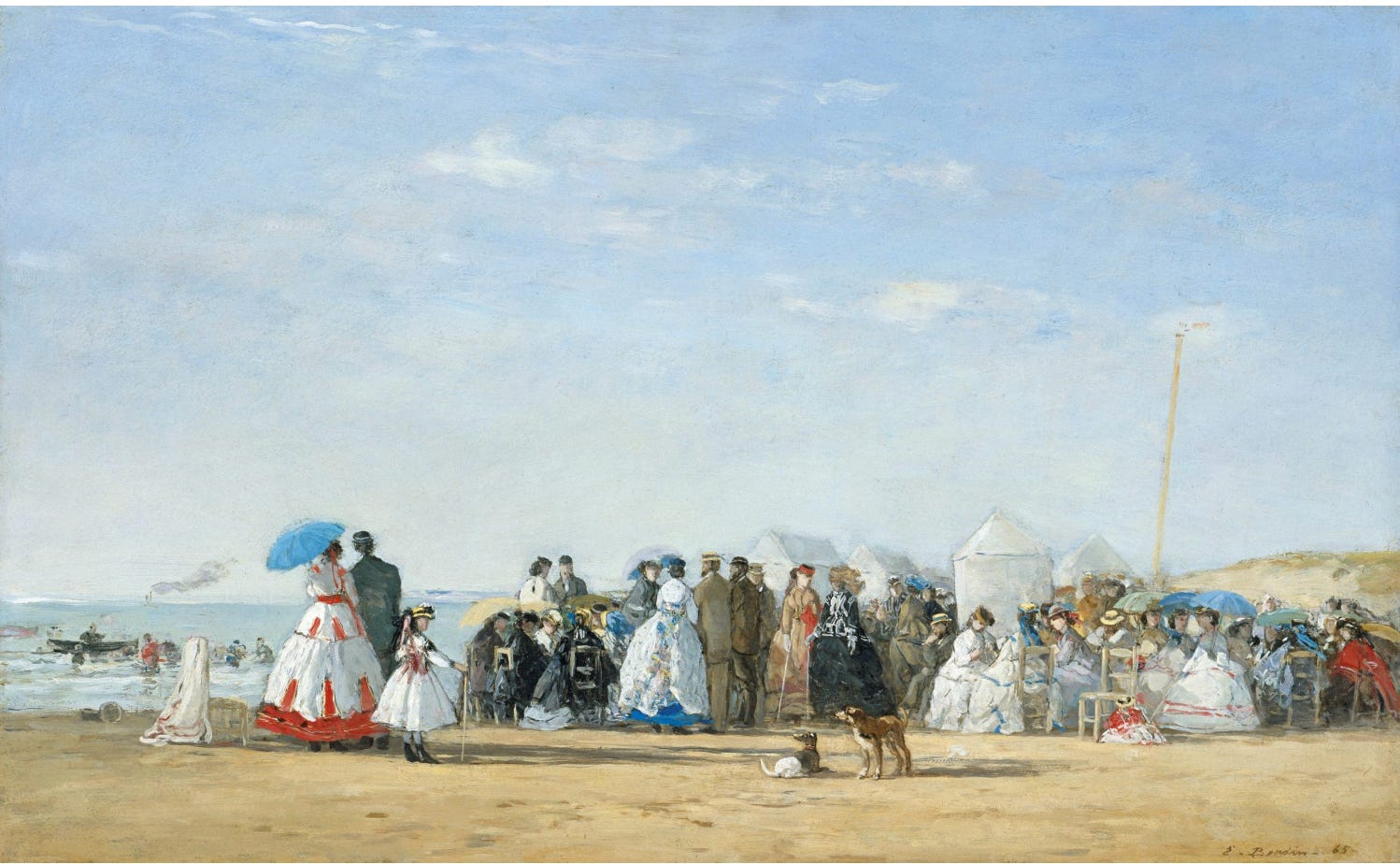
Some people might walk past this painting and see something dull, decorative, old-fashioned. Let’s look closer.
Boudin was obsessed with fleeting weather and clouds, and he loved to paint the well-dressed crowds who flocked to the beaches of Trouville and Deauville. This painting catches a pivotal cultural moment: the arrival of train travel in the 1850s had brought the seaside within reach of middle-class Parisians for the first time, and they came — with their best clothes, their chairs, their tents, their food transported from Paris — to discover leisure.
He painted it all outdoors, en plein air, and it shows. Two-thirds of the canvas is sky. Air fills the composition the way wind fills the crinolines of his female figures — it breathes. Beneath those clouds, the crowd hums with life. Even the dogs in the foreground seem to relax. Further back, figures wade near a boat, and on the horizon, a ship exhales a thread of smoke.
What looks at first like a pretty gathering is also a quiet document of modernity. The train, the steamship, the open air — these were not incidental; they were the engines of a new world. France was opening up, and plein air painting carried that freshness outward, offering ordinary people a vision of the world beyond the city. Travel changed painting; painting changed how people saw travel; and slowly, the world tilted toward a different kind of progress.
Like Meyerowitz — one hundred years later — Boudin captures crowds of strangers sharing a moment of light, just before the scene dissolves.
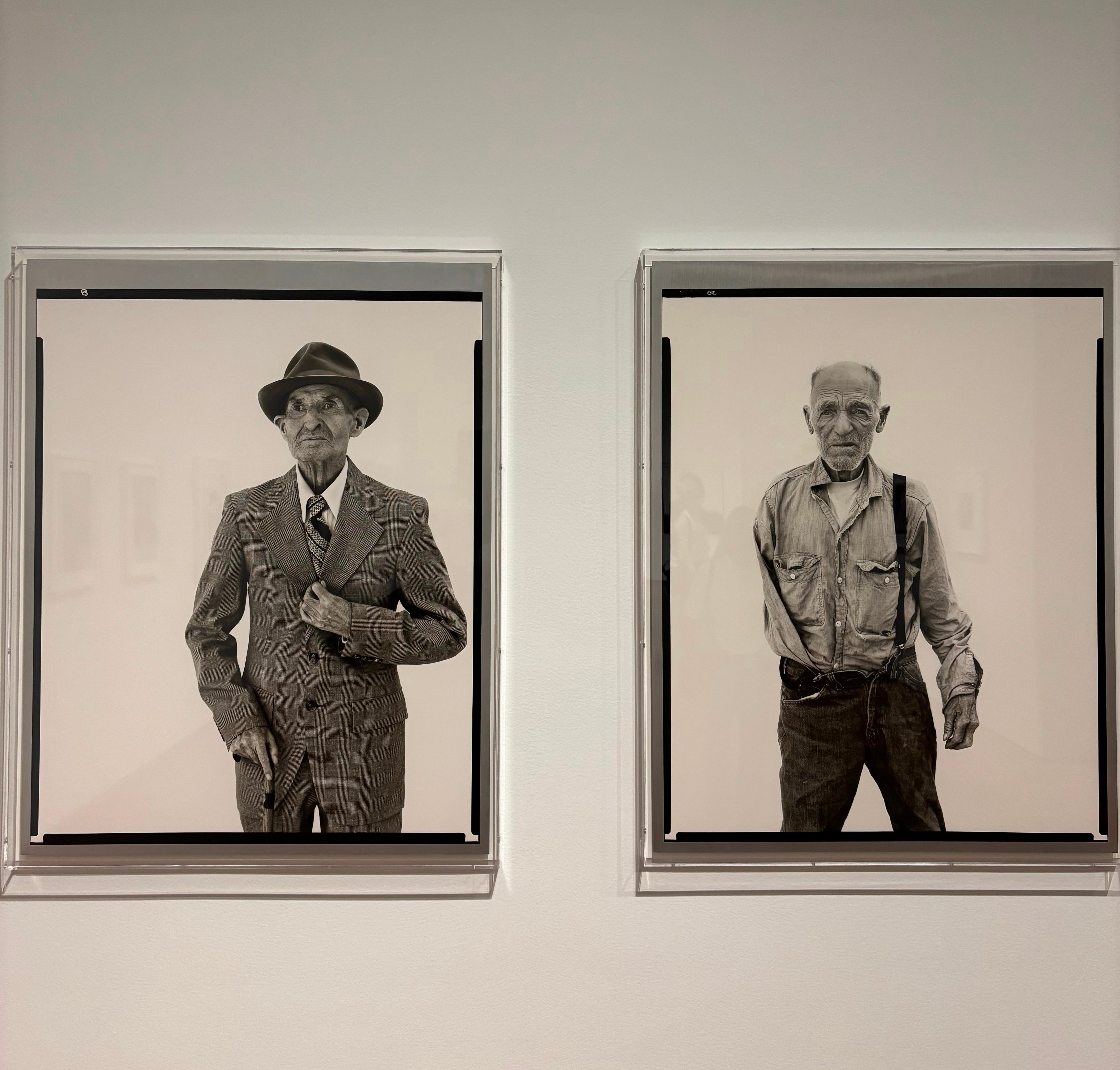
Finally, two photographs from an extraordinary exhibition of Avedon’s portraits at the Musée des Beaux-Arts, Montreal. These side-by-side photos struck me in a gallery mostly filled with famous faces. Like the artworks above, these are rooted in history; these photographs grasp a moment in time.
In the American West was a five-year project in which Avedon photographed miners, herdsmen, showmen, drifters, and transient workers — alone or in small groups — against a plain white background that stripped away all context, leaving only the person. He travelled through 13 states and 189 towns, conducting 752 sittings and exposing 17,000 sheets of film. The resulting 124 photographs tell a story of America in the early 1980s — Reagan's America — seen not from the top, but from the ground.
What made the project radical was the white backdrop itself, borrowed from his commercial work. In his fashion and celebrity portraits, it was a neutral device; here it became something democratic. A drifter commanded the frame with the same authority as any head of state. These large, nearly life-size photographs treat their subjects — contradictory, weathered, ordinary, extraordinary — with the reverence Renaissance painters reserved for saints. Avedon was lifting the everyday into the realm of the sublime.
He seems to ask: What does it mean to truly look at a stranger? Standing before these two photographs was humbling. Who were these men? What were their dreams and desires? Their struggles and challenges? What is written in the lines on their faces? Out of the hundreds of photos, why did he pick these two?
The man on the left is dressed up for Good Friday. Wearing his finest clothes, he washes away the signs of his labour and prepares to attend church. The way he holds his jacket's top button conveys his desire to look smart, showing up as the man he is. The man on the right has lost an arm, maybe in a work accident, and it makes him lopsided. Yet his face is wise, weather-beaten and has seen it all.
Both men have worked hard. Both have built something. Both have contributed in ways that will go largely unrecorded.
The longer I looked, the less strange they became.
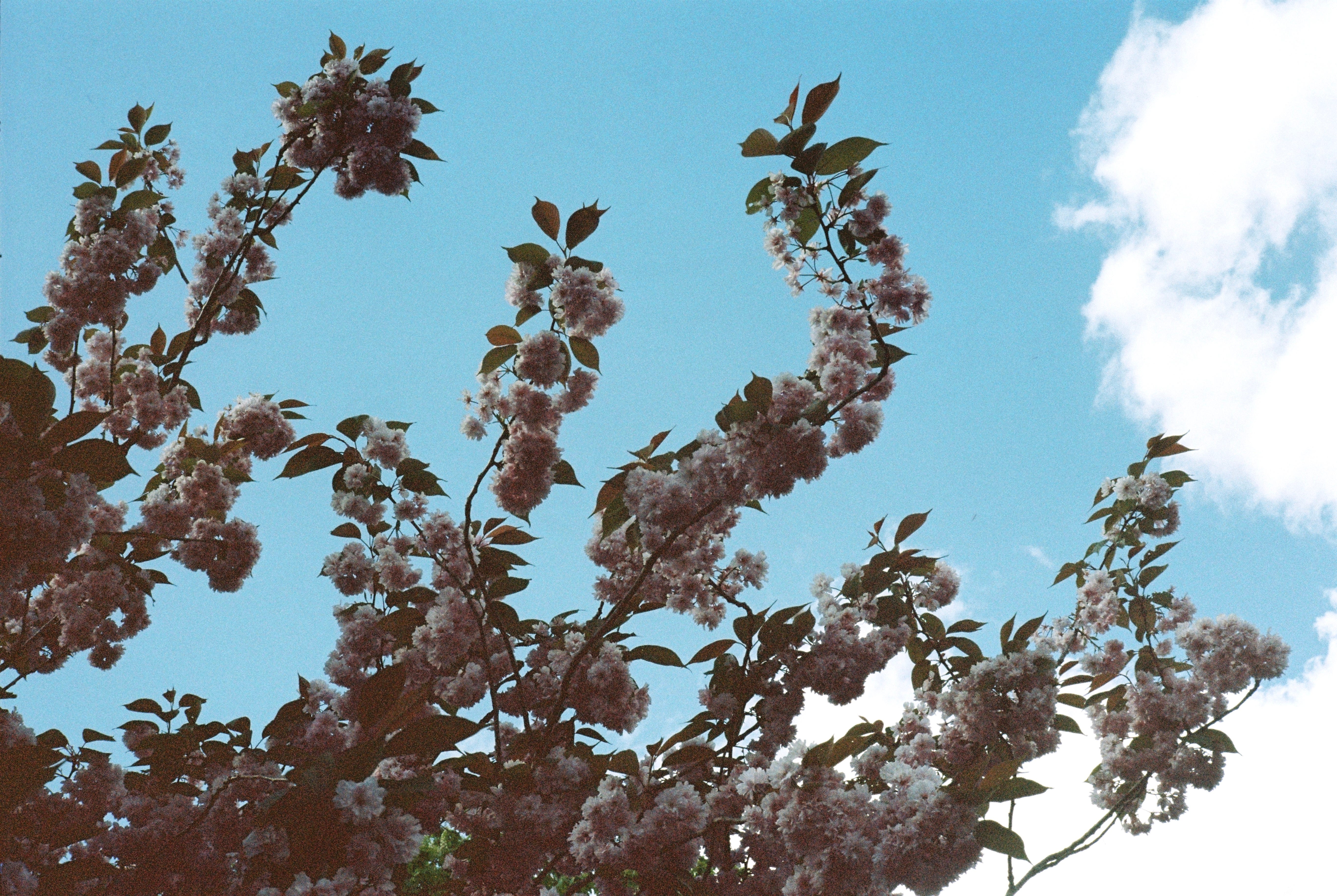
That is the real lesson in looking. We notice more, and when we do, things become less strange. We see a moment in time — the world as it was — and briefly, it is ours.
Even the green-eyed girl holding a unicorn is pulled from the coffers of time to be here with us. That girl lived, and Raphael made his choices, just as Meyerowitz and Avedon made theirs.
We move fast. When did you last bend your nose to a giant rose, or stand before a painting and wonder what the wind felt like that day, or look into the eyes of a stranger’s face and really see them, or fall into the colourful world of 1960s Paris?
Looking slows time down.
This is what art offers us, if we let it. Not answers, but attention. Not certainty, but wonder. Every painting and photograph we looked at in this essay has asked the same quiet question: Are you paying attention? Raphael, Boudin, Meyerowitz, Avedon — each of them looked, really looked, and in doing so, left us something to return to. Art teaches us to see. All we have to do is accept the invitation.
Thank you for reading. It would make me so happy if you tapped the heart button, and it would help bring more readers to my little corner of this virtual world.
Sam x