
Art as cure
when you don't know what to say, do, write or think

“Sometimes I feel so angry, then I go sit down at my desk, and I write.”
Toni Morrison
Every week, I come into this beautiful space, my corner of the Internet, to write. This week, I felt stumped. What could I say?
Everyone I have spoken to recently has said something similar: What can we say? What can we write? What can we do?
Do we commit to ostriching-that lovely, safe, blinding feeling of hiding our heads in the sand, or do we address this strange time we live in? I tend to be in the school of the former, but that is not always the best route forward.
A close friend bemoaned the fact that she couldn’t post her weekly thoughts on LinkedIn in the face of all this conflict. Ideas and words seemed trite. I suggested that she just share something good, something beautiful, something healing; that’s what people want. She did, and it was perfect.
In the past few days, I have read subtle yet powerful nudges towards the healing power of the arts. In the FT, I read about how art can be a cure, in their review of the book: Art Cure by Daisy Fancourt. “Art offers the brain the equivalent of a whole body workout, Fancourt writes. “Art stimulates dopamine in a measured manner that drugs can’t begin to match.” Elif Shafak, promoted by the Toni Morrison quote above, asked: “Can we take our anxiety and turn it into art?” She ponders, at the end of her recent essay, whether “maybe art, maybe writing, is how we cauterise the wounds that we know are not going to heal easily.”
It is a strange and unstable time. The world order is upturned and everything we held as true is now upside down, rules are tossed and discarded, as if a mad toddler mid tantrum has wrecked the house. There is a seemingly unstoppable force that defies sense and reason. What can we cling to and where can we find the glimmer?
As always, I turn to beauty and the lessons in art. Today I am going to share four things that offer both relief and inspiration.
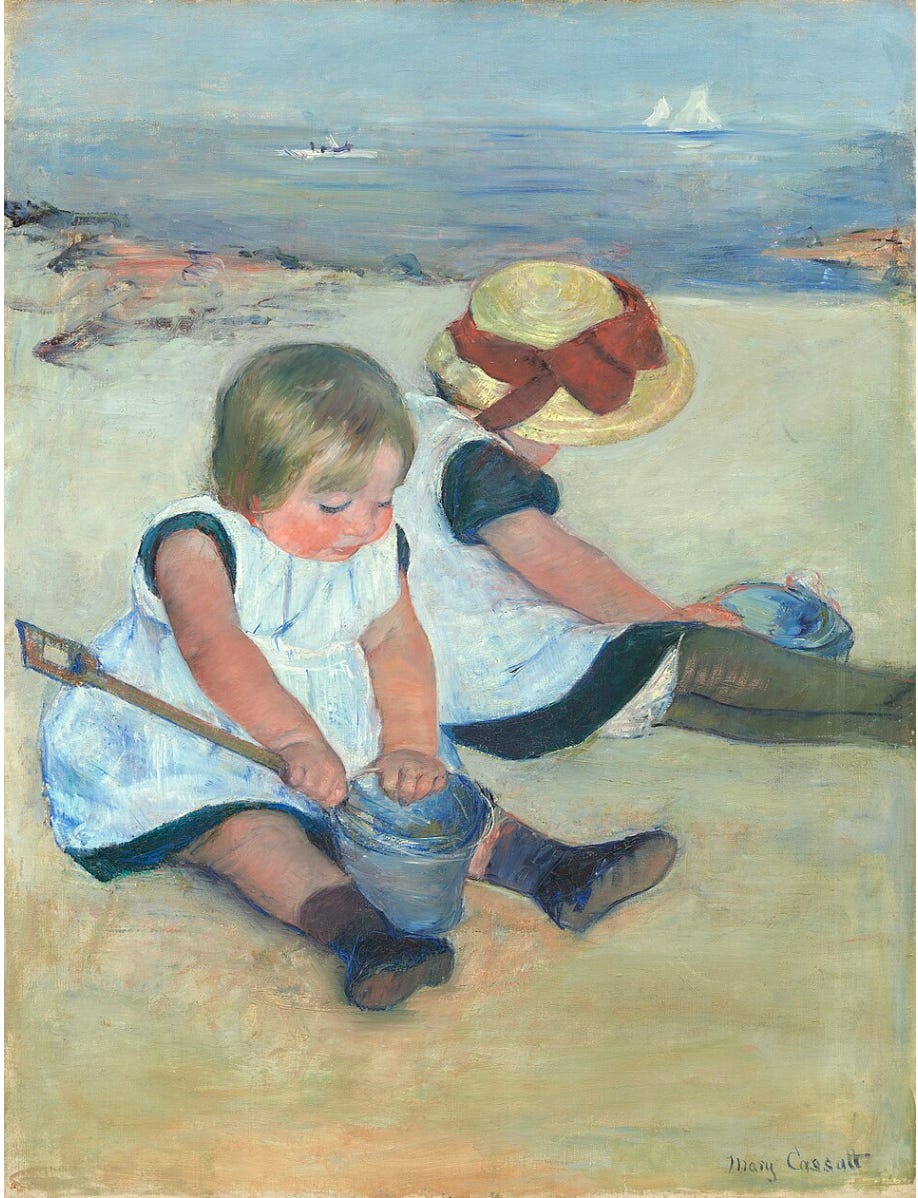
A painting of children playing, such simplicity! I have the postcard of this painting on the wall in my office, so it accompanies me as I work, write and think. I am drawn towards these two children, engrossed in play on the beach. Cassatt has captured their innocence with tenderness and paint, and she pulls us into their world, a secret world apart from the people and boats in the distance. The pudgy hands gripping the bucket, the set of their shoulders showing their concentration, and their heads tilted away from us help us to enter their close-cropped world. Together but separate, they parallel play, discovering, learning and making something out of sand. Nothing will last, not childhood, not this day on the beach and not the sandcastles they will make, yet none of this bothers them. This painting is a lesson in being present with what we have in front of us. The people, the art, the play, the work.


Rodin’s Kiss is so well known that there is a danger we will walk past with a mere nod of recognition before moving on to something else. But today, let’s stop and look closer. There is something powerful about looking twice at something we consider known. Looking at these two bodies utterly lost in each other, the world falls away. It was shocking for its time, radical in its depiction of physical abandon and desire. But there is more to the story than that. The couple are the adulterous lovers Paolo Malatesta and Francesca da Rimini, who were slain by Francesca’s outraged husband. They appear in Dante’s Inferno, which describes how their passion grew as they read the story of Lancelot and Guinevere together. The book can just be seen in Paolo’s hand. Rodin decided to depict the lovers at the moment of their first kiss, overcome with desire, the stories, the news, the people in their lives, it all disappears. Nothing remains but this singular moment. The sculpture’s fame is rooted in how Rodin captures this moment of abandonment, rarely seen in a life-size marble or bronze. When we walk around it and notice the gentleness of their hands and arms, the embrace hot despite the cold stone, we appreciate skill, certainly, but we might also feel the flutter in our own hearts, we know that feeling, we recognise it as central to being human, breathing, warm and alive. I love the paradox of a cold piece of stone carved over 120 years, teaching us something about love.
FOUR QUARTETS by T.S. Eliot is a mammoth work of poetry, insight and philosophy. I have written before about the “still point of the turning world,” and this extract comes from the same poem, BURNT NORTON (No. 1 of ‘Four Quartets’). Here, T. S Eliot shares the voice of a bird, who tells us that humankind cannot bear much reality. It is too hard for us to digest, so we must turn to what is always present. In Burnt Norton, Eliot explores how to transcend the limitations of human existence, and the bird offers a divine perspective, helping us catch glimpses of the eternal in the midst of our troubled and confusing days.
Go, said the bird, for the leaves were full of children,
Hidden excitedly, containing laughter.
Go, go, go, said the bird: human kind
Cannot bear very much reality.
Time past and time future
What might have been and what has been
Point to one end, which is always present.
Finally, a song from 1969, Girl from the North Country, by Bob Dylan, and sung in harmony by two men lamenting a lost love. The song refers to the cold, northern Minnesota territory where a girl has been left behind as this folk singer travels, like a troubadour, to find a new life. It is steeped in nostalgia, memories of home and a yearning for a time now past. It is a melancholic ballad that echoes the traditional folk song, Scarborough Fair, which lists impossible tasks given to a former lover. I listened to it many times before writing this essay, and each time the melody, poetry and voices of Dylan and Cash transported me, far away from a hot and humid Singapore to a place of stories and fairy tales. The pain of lost love endures, makes melody and lingers long after the beauty fades. This song is a lament that calls to us to remember, to hold close, to sift through our memories.
I'm a-wonderin' if she remembers me at all
Many times I've often prayed
In the darkness of my night
In the brightness of my day
Toni Morrison, in her anger, sat down to write, her mind and hands troubled with leisure. When we don’t know what to say, to write or even to think, we must turn to the tools we have. Art can unlock health and happiness; the arts are not luxuries but powerful tools for our peace of mind- art is the answer in troubled times. Let us turn to what is fierce and loving, not only decorative or beautiful, but alive.
Thank you for reading, I hope this space has lifted and brightened you today. Please tap the heart button if you enjoyed this post, it helps people find me and grow Notes from the Middle. Sam x